
Chain, Belt or Wall-Mount Openers: Choosing the Right Drive Type for Your Garage
Chain, belt, screw and wall-mount jackshaft openers all move a garage door differently. Here's what actually separates them, and how to pick the right one for a Springfield garage.
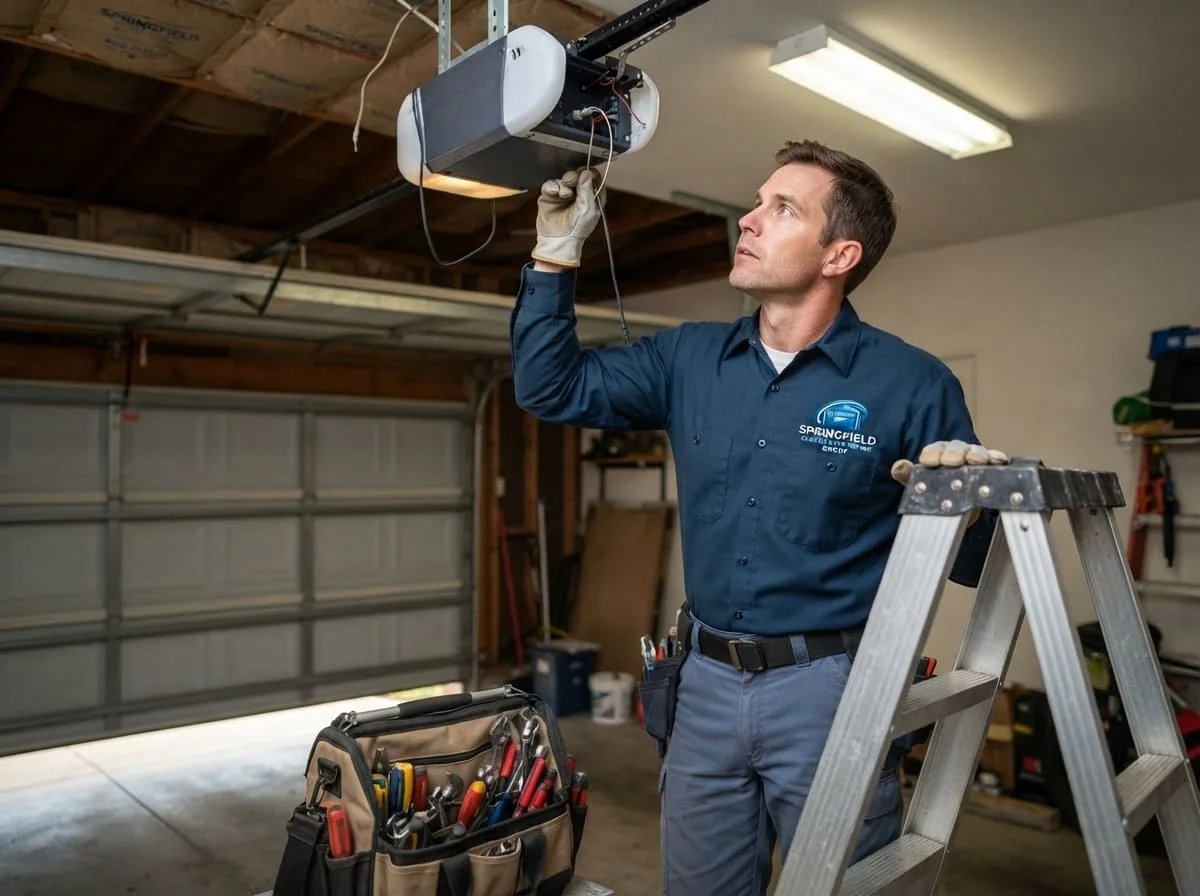
How an Opener's Drive System Actually Moves the Door
Every residential garage door opener does the same basic job: it turns a motor's rotation into a pulling force that raises and lowers the door along a track. Where openers differ is in the mechanism that carries that force from the motor to the door itself, and that mechanism is what people mean when they talk about "drive type" — chain, belt, screw, or a wall-mounted direct drive, sometimes called a jackshaft opener.
It helps to be clear on one thing first: in a properly working system, the opener is not lifting the dead weight of the door. That job belongs to the torsion springs mounted above the door, which are wound to counterbalance the door's weight so that a correctly balanced door can be lifted by hand with one or two fingers. The opener's motor only has to move the door along that already-balanced path and hold it in place at the top and bottom of travel. This matters when you're comparing drive types, because a chain, belt, or screw doesn't determine how heavy the door feels — spring balance does that. The drive type determines how smoothly, how quietly, and in some cases how much ceiling space that motion takes up.
With that distinction in mind, here's what separates the four drive types you'll run into on a typical residential job.
Chain Drive Openers: The Workhorse
A chain drive uses a metal roller chain, similar in principle to a bicycle chain, running the length of a rail bolted above the door opening. The motor turns a sprocket, the sprocket pulls the chain, and the chain pulls a trolley connected to the door by an arm. It's a simple, direct mechanism, and it's been the standard residential option for decades because it's inexpensive to build and holds up well under repeated heavy use.
Chain drive tends to be the choice for heavier doors — real wood carriage-style doors, insulated steel doors with two layers of panel and foam, or oversized double doors — because the direct metal-to-metal connection handles sustained pulling force without much give. The trade-off is noise. Metal moving against metal, plus the vibration of the chain traveling the rail, transmits into the header and ceiling joists above the door. In a garage that sits under an unused attic or is detached from the house, that's rarely a problem. In a garage with a bedroom or living space directly overhead, it's the drive type most likely to be noticed at 6 a.m. or 11 p.m.
Chain systems also need occasional tension adjustment. As the chain cycles through thousands of open-and-close cycles, and as temperature swings cause the metal rail and chain to expand and contract, some slack develops. That shows up as a clunk or rattle at the start of travel, and it's a normal, low-cost adjustment rather than a sign of failure — though ignoring it for years can accelerate wear on the trolley and sprocket.
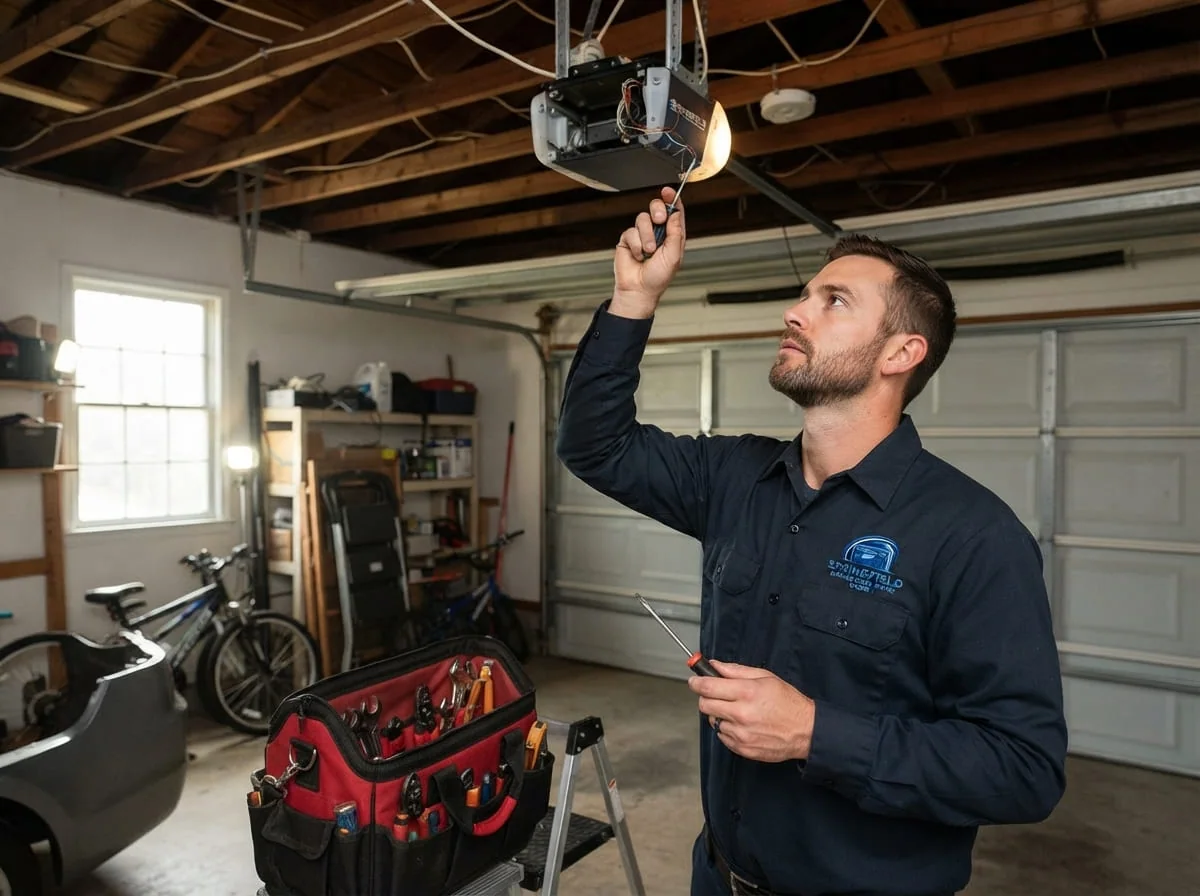
Belt Drive Openers: Quieter Operation
A belt drive uses the same trolley-and-rail layout as a chain drive, but the pulling element is a reinforced belt — usually rubber or polyurethane with steel cording or fiberglass strands run through it for strength — instead of a metal chain. Because there's no metal-on-metal contact at the sprocket, belt drives run noticeably quieter, and they transmit far less vibration into the structure above the garage.
That quieter operation is the entire reason belt drive exists, and it's the most common reason homeowners choose it over chain: an attached garage with a room above it, a shared wall with a bedroom, or simply a household with someone who works nights and sleeps during the day. Beyond noise, a quality reinforced belt holds up well in Springfield's winters — it doesn't turn brittle the way older, non-reinforced rubber components could, and it doesn't develop the same cold-weather slack that a chain can. It still deserves a visual check periodically for fraying at the edges after years of cycling, since a belt is the one component that does eventually wear through rather than just needing re-tensioning.
Screw Drive Openers: Fewer Moving Parts
A screw drive replaces the chain or belt with a threaded steel rod that runs the length of the rail. The trolley has an internal thread that matches the rod, so as the rod spins, the trolley travels directly along it — no separate chain, belt, or set of sprockets involved. Fewer components generally means fewer things that can wear loose over time, and the sound it produces is a steady low mechanical hum rather than the clank of a chain.
The trade-off with screw drive is temperature sensitivity. The threaded rod needs a specific grease to travel smoothly, and that lubricant thickens in cold weather. In an unheated Springfield garage in January, with overnight lows commonly dropping into the high teens, a screw drive opener can run noticeably slower and put more strain on the motor until things warm slightly with use. Keeping the rod lubricated with a grease rated for cold-weather use matters more for this drive type than it does for chain or belt. Screw drive is installed less often on new residential doors today than chain or belt, but it still shows up, particularly when a job needs to match an existing rail length or a specific mounting configuration.
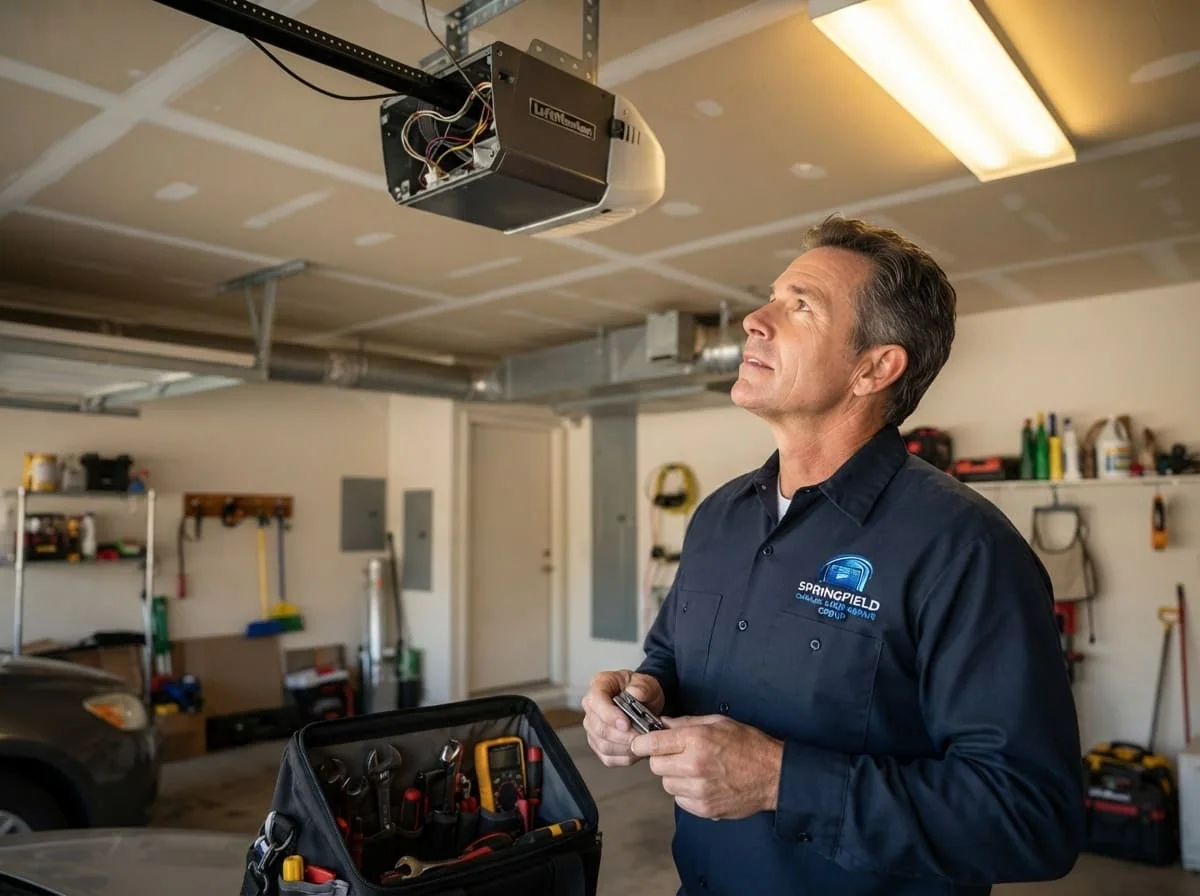
Wall-Mount (Jackshaft) Openers: Giving Up the Rail Entirely
A wall-mount, or jackshaft, opener works differently from the other three. Instead of mounting to the ceiling and pulling a trolley along an overhead rail, it mounts to the wall beside the door and connects directly to the torsion spring shaft. The motor turns that shaft itself to wind and unwind the springs, raising and lowering the door without any rail running across the ceiling at all.
The appeal is straightforward: the entire ceiling above the door stays open. That matters in a garage doing double duty as a workshop, a home gym, or storage for a ceiling-mounted bike rack or overhead shelving system, and it matters for taller vehicles or lifts that need clearance a rail-mounted trolley would otherwise occupy.
Jackshaft openers do come with real requirements. The door needs a functioning torsion spring system with a shaft the unit can attach to — this style doesn't adapt cleanly to an extension-spring setup without modification. There has to be enough clear wall space beside the opening for the unit itself, and enough clearance around the shaft for it to rotate freely. Because of that, wall-mount is far more often specified during a new installation or a full door replacement, when the spring shaft and mounting conditions can be set up correctly from the start, rather than retrofitted onto an older existing door.
Matching Drive Type to Your Garage and Springfield's Climate
Central Illinois winters run cold — January in Springfield averages a high near 33°F and a low near 18°F, with regular snow — and that has real consequences for how a garage door opener behaves, regardless of which drive type is installed. Metal rails and chains contract in the cold, which can tighten tolerances or introduce slack depending on the system. Lubricant on any moving part, chain, screw rod, or hinge, thickens when temperatures drop, and nylon rollers can become more brittle. None of this means one drive type is dangerous in the cold; it means routine seasonal attention pays off no matter which system you have.
Beyond climate, the layout of the garage itself is often the deciding factor. In a lot of Springfield's older near-north-side homes — the Victorian and Craftsman-era houses around Enos Park, for instance — attached garages sit close to living space, and some were built with lower ceiling clearance than modern construction allows for. That combination favors either a belt drive, for noise, or a wall-mount unit, for garages where ceiling clearance for a rail is tight or where the space above the door is needed for storage. In a detached garage, or one used mainly for parking and yard equipment with no bedroom overhead, a chain drive's lower cost and higher pulling force for a heavier door often make more practical sense.
Horsepower, Door Weight and Lifting Capacity
Openers today are often rated by lifting capacity or a comparable horsepower figure rather than raw horsepower alone, especially with modern DC motor units. Whatever the rating system, the same rule applies across all four drive types: a heavier door — solid wood, an insulated steel door with two layers of panel and foam backing, or an oversized double-wide door — needs an opener rated for that additional weight, independent of whether it's chain, belt, screw, or wall-mount.
It's worth repeating that the opener's rated capacity assumes the door is properly balanced by its springs first. An underpowered opener paired with a heavy or poorly balanced door doesn't just struggle — it works harder on every cycle, and that extra strain shortens the life of the motor and the drive component alike, no matter which type it is. If a door has ever felt unusually heavy to lift by hand with the opener disconnected, that's a spring or balance issue to address before opener selection matters much at all.
What Actually Drives the Cost of a New Opener
We don't publish flat prices here because the honest answer is that cost depends on several variables specific to your garage, and we'd rather diagnose the actual job than guess at a number that doesn't apply to your door. The factors that genuinely move the cost include:
- The lifting capacity required for your door's size, weight, and material
- The drive type itself — a wall-mount jackshaft unit typically involves more installation labor and a shaft compatibility check than a straightforward chain or belt swap
- Whether the existing rail, header bracket, and wiring can be reused or need full replacement
- Additional features like battery backup for power outages or smartphone/app connectivity
- Rail length needed for high-lift or vaulted-ceiling track configurations
- The condition of the safety reversing sensors and whether they need to be replaced or realigned as part of the job
Springfield Garage Door Repair Group looks at the actual door and opener setup before quoting anything, and provides that quote upfront, in writing, before any work begins. That's the same standard whether the job is a straightforward chain drive swap or a full wall-mount conversion tied to a new door installation.
Comparison at a Glance and How to Decide
| Drive Type | Typical Noise Level | Ceiling Space Used | Generally Best For |
|---|---|---|---|
| Chain | Louder — metal-on-metal | Full rail overhead | Detached garages, heavier doors, workshops |
| Belt | Quieter | Full rail overhead | Attached garages, rooms above the garage |
| Screw | Moderate, steady hum | Full rail overhead | Simpler mechanism; needs cold-weather lubrication |
| Wall-mount (jackshaft) | Quiet at the ceiling | None — mounts beside the door | Garages needing open ceiling space; torsion-spring systems only |
None of these is a wrong answer in the abstract — each one is a genuine engineering trade-off between cost, noise, and how much of your ceiling you want to keep free. If your garage sits under a bedroom, weight noise and vibration first. If you need the ceiling for storage or a workshop setup, wall-mount deserves a serious look, provided your door has the torsion spring shaft it requires. If you're simply replacing a worn-out chain drive on a detached garage with no one sleeping above it, there's often no compelling reason to pay more for something else. We're happy to walk through your specific garage, door weight, and layout and talk through which drive type actually fits, rather than defaulting to whichever one is easiest to sell.

Grant Callahan
Owner and lead technician at Springfield Garage Door Repair Group, serving Springfield, IL since 2013.
FAQs
How much does it cost to replace a garage door opener in Springfield?
It depends on the lifting capacity your door needs, the drive type you choose, whether your existing rail and wiring can be reused, and any added features like battery backup. We look at your actual door and opener before quoting anything, and we provide that quote upfront, in writing, before starting work — no guessing over the phone.
Can I install a new garage door opener myself?
Some homeowners do, and a straightforward swap using the existing rail can be within reach for someone comfortable with basic electrical and mechanical work. Where people run into trouble is rail alignment, torsion spring proximity, and correctly aiming and testing the photoelectric safety sensors, which federal safety standards require to reverse the door if something is in its path. If any of that isn't set up correctly, it's a real safety issue, not just an inconvenience — that's the part worth having checked by someone experienced even on a DIY install.
How long do garage door openers typically last?
Many residential openers give a decade or more of reliable service with basic seasonal maintenance. That said, the motor and the drive component don't always wear at the same rate — a chain or belt may need adjustment or an individual part replaced well before the motor itself fails, and keeping up with that upkeep is usually cheaper than waiting for a full replacement.
Is a belt drive worth paying more for over a chain drive?
If your garage is attached to the house and there's a bedroom or living space above or beside it, most homeowners find the quieter operation worth the difference. If the garage is detached, or sits under unused attic space with no one sleeping nearby, a chain drive's lower cost and strong pulling force for heavier doors often makes more practical sense.
Will a wall-mount jackshaft opener work with my existing garage door?
Only if your door has a torsion spring system with a shaft the unit can attach to, plus enough clear wall space beside the opening and clearance for the shaft to rotate. It's not a universal retrofit — we'd need to inspect your specific spring and shaft setup before confirming it's a fit, which is why wall-mount openers are more commonly installed alongside a new door or full replacement.
Why does my chain or screw drive opener get noisier in the winter?
Cold temperatures cause the metal rail and chain to contract, which can introduce slack that shows up as a clunk or rattle, and any grease on a screw drive's threaded rod thickens in the cold and needs to travel more freely to run smoothly. Neither is usually an emergency, but ignoring it season after season does accelerate wear on the trolley and drive components.
Have a Garage Door Problem Right Now?
Skip the guesswork — call Springfield Garage Door Repair Group for a fast, honest diagnosis.