
Torsion vs Extension Springs
Torsion and extension springs do the same job in completely different ways, and that difference matters when one of them breaks. Here's how to tell what's on your door and why it changes the repair.
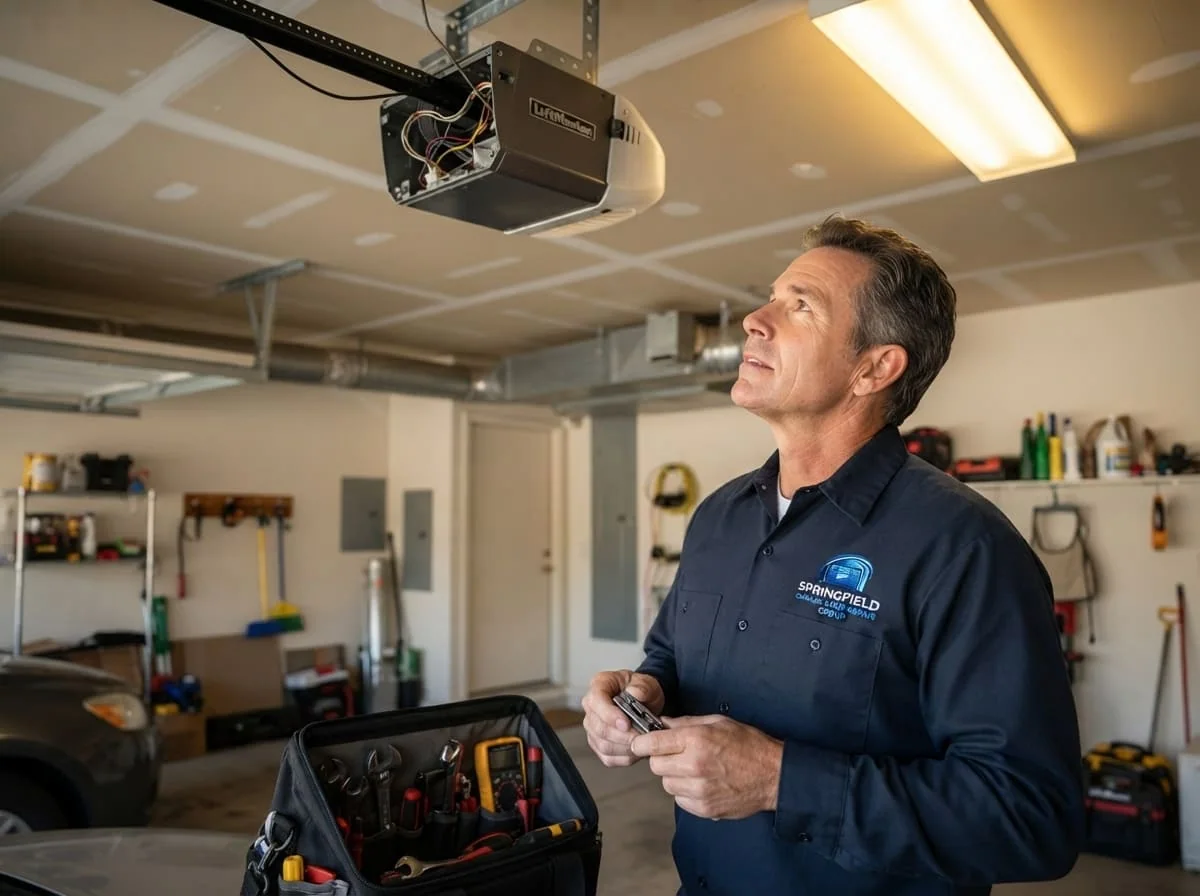
Why the Spring Type Matters More Than Most Homeowners Realize
Most homeowners call us and say the same thing: "my spring broke." That's usually true, but it's only half the story. A garage door doesn't have one universal spring design. It has two entirely different systems that happen to do the same job, and knowing which one is on your door changes how it fails, how dangerous a failure is, and what a proper repair actually involves.
In my years working overhead doors on state facilities crews around the Capitol complex, then running my own shop here in Springfield since 2013, I've replaced both types more times than I can count. Torsion springs and extension springs both store the energy that lifts a door weighing anywhere from 130 to over 400 pounds, but they store it differently, release it differently, and fail differently. Get the type wrong when you're troubleshooting or shopping for a repair, and you can end up with a system that doesn't match your door, or worse, a repair that doesn't account for the real risk involved.
This isn't a listicle problem. It's a mechanical one, and it's worth understanding even if you never plan to touch the springs yourself.
How Torsion Springs Work
Torsion springs are the system you'll find on the vast majority of garage doors built or replaced in the last two to three decades. They mount horizontally on a metal shaft directly above the closed door, usually one or two thick coiled springs sitting side by side, anchored to a center bracket and stretching out toward cable drums on each end.
When the door closes, the springs wind up along the shaft, storing torque, which is rotational force rather than a straight pull. As the door opens, that stored torque unwinds through the shaft, turning the cable drums, which pull the lift cables and take the weight off your arms (or the opener) as the door rises. It's the same physics as winding a mechanical clock: energy goes in during one motion and releases in a controlled way during the opposite motion.
Torsion systems are rated in cycles, meaning one full open-and-close movement, not years. A standard-duty torsion spring is commonly built for somewhere in the 10,000-cycle range, with higher-cycle springs available for households that open the door more often or want longer service life before replacement. DASMA, the industry association for door and access systems manufacturers, publishes cycle-life reference standards under ANSI/DASMA 102 and technical data sheet TDS-190, which is the framework most manufacturers use to rate spring durability. A family that opens the garage door four times a day will reach a 10,000-cycle spring's rated life in roughly seven years; a household with two commuters and kids in and out constantly will get there faster.
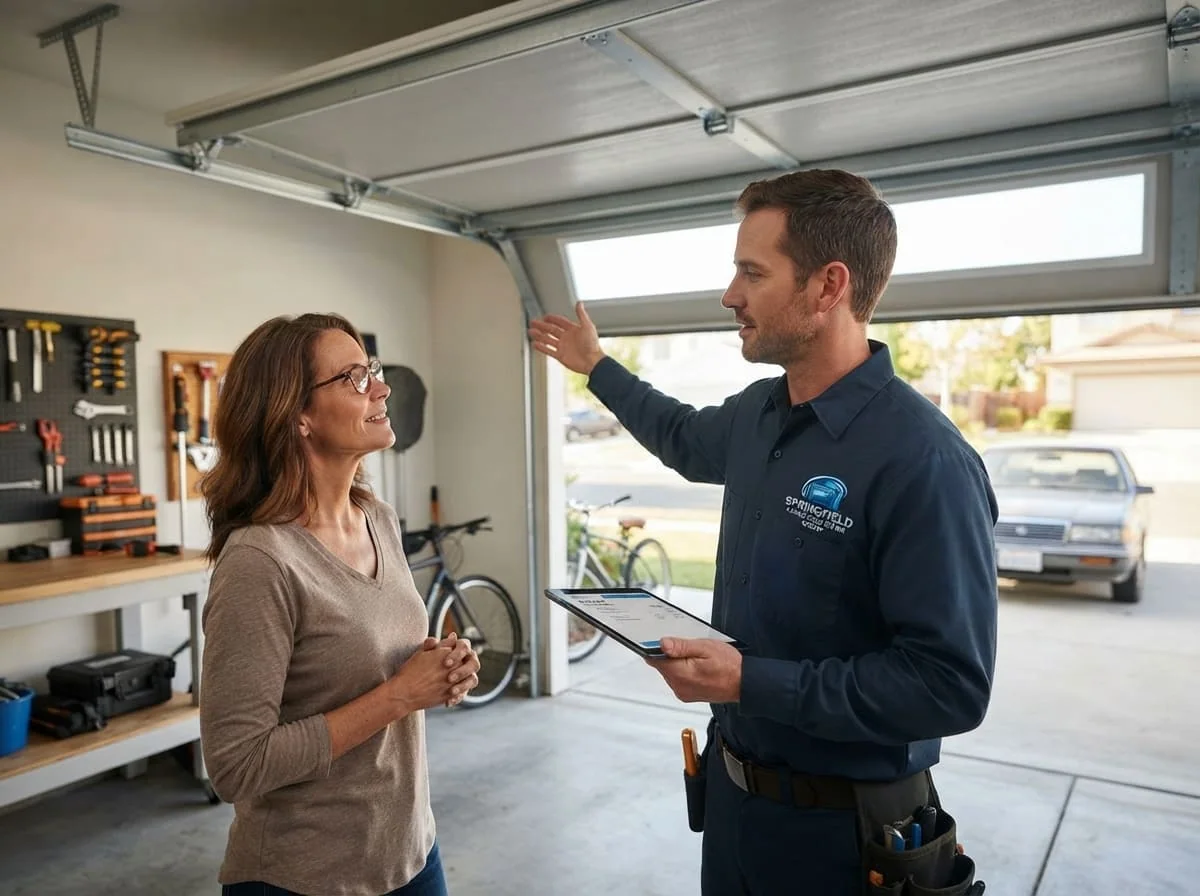
How Extension Springs Work
Extension springs are the older technology, still common on garage doors installed before the 1980s and 90s shift toward torsion hardware, and still present on plenty of homes in Springfield's older neighborhoods, including some of the Victorian and Craftsman-era houses around Enos Park. Instead of one shaft above the door, extension springs run horizontally along the upper track on each side of the door, one spring per side.
As the door closes, these springs stretch, or extend, storing energy in tension rather than torque. As the door opens, the springs contract back toward their resting length, and that contraction pulls a pulley-and-cable system that helps lift the door. It's a simpler design mechanically, which is part of why it was cheaper to manufacture and install for decades, and why you'll still find it holding up plenty of functional doors today.
The tradeoff is in how the stored energy behaves if something goes wrong. A torsion spring failing releases torque along a fixed shaft. An extension spring failing releases a stretched piece of coiled steel that has nowhere controlled to go unless something is specifically designed to contain it. That distinction drives most of the safety differences between the two systems, which is worth its own section.
Torsion vs Extension: A Side-by-Side Look
| Factor | Torsion Springs | Extension Springs |
|---|---|---|
| Mounting location | Single shaft above the closed door | Along the horizontal tracks, one spring per side |
| How energy is stored | Torque (twisting force) along the shaft | Tension (stretching force) along the spring's length |
| Typical door age/type | Most doors installed in recent decades | Common on older installations, still functional on many homes |
| Failure behavior | Shaft stops turning; door usually stays roughly in place until moved | Can release stored tension suddenly unless properly restrained |
| Required safety hardware | Center bracket, cable drums, set screws | Safety/containment cables running through the spring's core |
| General serviceability | Cycle-rated by manufacturers per ANSI/DASMA 102 | Also cycle-rated, though often lower duty cycles than modern torsion units |
Neither system is inherently "bad." A well-maintained extension spring setup with proper safety cables in place can serve a household for years. What matters is whether the system on your door is complete, correctly matched to your door's weight, and inspected before it becomes a hazard rather than after.
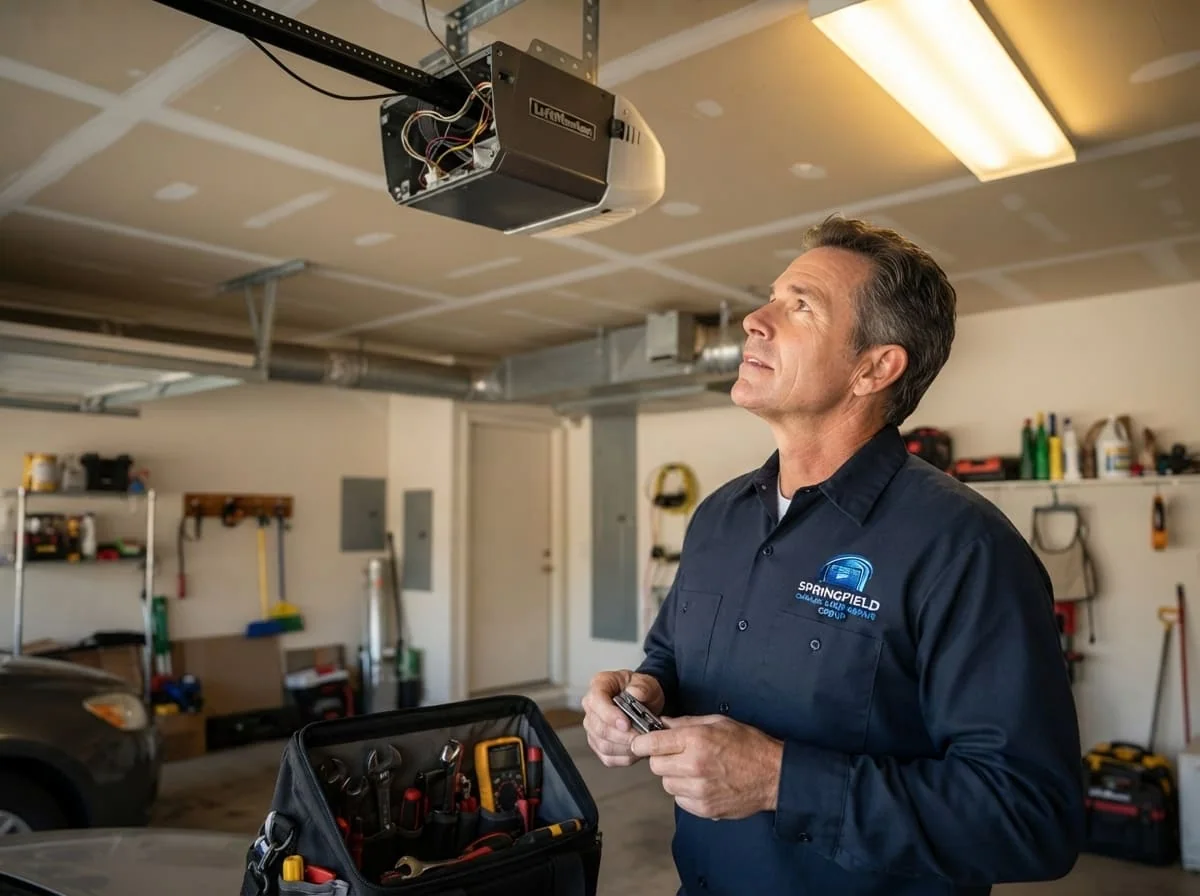
The Safety Gap Between the Two Systems
This is the part I explain to nearly every customer with an older extension spring setup, because it's genuinely important and not something to gloss over. The U.S. Consumer Product Safety Commission has published guidance for years on extension spring systems specifically because of how they fail: a stretched spring under tension that snaps or detaches from its anchor point can travel with real force if nothing is holding it in place.
The fix is a safety cable, sometimes called a containment cable, that runs through the center of the extension spring and anchors independently at both ends. If the spring itself fails, the cable keeps it from becoming a projectile inside the garage. It sounds like a small piece of hardware, and it is, but it's the single most important safety feature on an extension spring system, and it's the first thing I check when I'm evaluating an older setup. Doors installed or serviced without one are carrying more risk than they need to.
Torsion springs have their own failure risks, mainly around the shaft, cable drums, and the tension involved in winding and unwinding them, which is exactly why this is not a job to improvise. But the specific hazard of a spring physically launching across a garage is much more associated with unrestrained extension springs, and it's the reason CPSC guidance exists on this exact point.
How to Tell Which Type Is on Your Door
You don't need to be a technician to identify what's on your own door. Stand inside the garage with the door closed and look up.
- If you see one long shaft running horizontally directly above the door opening, with one or two tightly coiled springs sitting on that shaft, you have a torsion system.
- If instead you see long springs stretched out above each of the two horizontal tracks along the ceiling, roughly parallel to the tracks themselves, you have an extension system.
- If you can't tell, or the springs look like they're missing a thin cable running through their center on an extension setup, that's worth a call rather than a guess.
Some homes, particularly ones that have had partial upgrades over the years, end up with a mismatched setup, like a newer opener paired with original extension springs from the 1970s. That's not automatically a problem, but it is something worth having a second set of eyes on, especially if you're not sure when the springs were last serviced.
Warning Signs Each Type Gives Before It Fails
Springs rarely fail with zero warning, though the warning often shows up as "the door feels heavier than it used to" rather than anything dramatic. A few things worth watching for, specific to each type:
Torsion springs: a visible gap or separation between coils, a spring that looks stretched out of its normal tight coil shape, a shaft that looks like it's sagging slightly, or a loud bang from above the door (springs typically fail with a sharp noise, not a slow leak). The door will often feel noticeably heavier to lift by hand once a torsion spring has gone.
Extension springs: visible rust or pitting at the hooks and anchor points, a spring that looks permanently stretched even with the door closed, a fraying or missing safety cable, or one side of the door lifting unevenly because one spring has weakened faster than the other.
Shared warning signs across both systems include the door reversing or struggling partway through opening, an opener that strains and makes a higher-pitched motor sound than usual, or cables that look loose or slightly frayed near the bottom brackets. Any of these is a reasonable point to stop using the opener and have the system looked at, rather than continuing to run a door on a spring that's already partially failed.
Why Springfield Winters Are Hard on Both Systems
Central Illinois winters put real stress on garage door hardware, and it affects both spring types, just not identically. Springfield's January average high sits near 33°F with lows around 18°F, cold enough that steel contracts measurably. A torsion or extension spring that's already near the end of its cycle life is far more likely to snap on a cold January morning than a mild October afternoon, because contracted metal has less give in it right at the moment the spring is asked to flex under full load.
Cold weather affects the rest of the system too. Nylon rollers get more brittle and are more prone to cracking in freezing temperatures. Track metal contracts slightly, which can make a door that was running smoothly in summer start binding or catching in the tracks. Lubricant on the springs and rollers thickens in the cold, adding friction right when the system needs to move as freely as possible. None of this means a spring failure is purely a winter phenomenon, plenty happen in summer heat and humidity too, but if your springs are already showing wear, a Springfield winter is the season most likely to be the one that finishes the job.
Why Spring Repair Isn't a Weekend Project
I'll be direct about this because it matters: both torsion and extension springs store enough energy, under enough tension, to cause a serious injury if you're not using the right tools and the right sequence. Torsion spring work in particular requires winding bars sized to the specific spring, not an adjustable wrench or a screwdriver, and a clear understanding of how much the shaft needs to unwind before it's safe to remove anything. Extension spring work carries its own risk if a containment cable isn't installed correctly or the spring is under partial tension when someone starts disconnecting brackets.
This is also where diagnosis matters more than people expect. A door that's hard to lift isn't always a spring problem. Sometimes it's a track alignment issue, a worn roller, or a cable that's slipped off a drum. Part of doing this work honestly means checking the whole system before assuming the springs are the culprit, and it means matching any replacement spring to your specific door's weight and cycle needs rather than grabbing whatever's on the shelf. That's the standard I hold every job to, whether it's a single spring on a residential door or the heavier-cycle hardware you'd see on a commercial overhead bay.
If your door is showing any of the warning signs above, the safest next step is having it looked at by someone who does this daily, not a trip to the hardware store on a Saturday morning.

Grant Callahan
Owner and lead technician at Springfield Garage Door Repair Group, serving Springfield, IL since 2013.
FAQs
Can extension springs be replaced with torsion springs on the same door?
In many cases, yes, a door originally built with extension springs can be converted to a torsion system, since torsion hardware generally offers a cleaner, more contained setup. It requires the right shaft, drums, and bracket hardware sized to your specific door's weight and track configuration, so it's worth having someone evaluate the door in person rather than assuming a straight swap. We're happy to take a look and walk you through whether conversion makes sense for your particular setup.
How long do garage door springs actually last?
Springs are rated in cycles rather than calendar years, with one cycle meaning one full open-and-close. A standard-duty torsion spring is commonly built around the 10,000-cycle range, per manufacturer standards referenced in ANSI/DASMA 102, with higher-cycle options available. A household opening the door a few times a day will typically reach that range somewhere in the seven-to-ten-year window, though heavier daily use, humidity, and temperature swings can shorten that. Extension springs follow similar cycle logic, often with somewhat lower duty ratings depending on the original hardware.
Is it dangerous to try to replace a broken spring myself?
Yes, and this is worth taking seriously rather than as a generic disclaimer. Both torsion and extension springs hold significant stored energy under tension, and releasing or resetting that tension requires specific tools sized to the spring and a clear sequence for doing it safely. This is one of the few home repair jobs where the injury risk is genuinely high enough that we recommend against a DIY attempt, regardless of how mechanically comfortable someone is with other projects.
How can I tell which spring type my garage door has without taking anything apart?
Just look up with the door closed. A single horizontal shaft with one or two tightly wound springs directly above the door opening means torsion. Long springs stretched out parallel to the horizontal tracks on each side of the ceiling mean extension. If you're unsure or notice a spring that looks like it's missing a cable running through its center, that's a good reason to have it checked rather than guess.
Do extension springs really need safety cables?
Yes. The Consumer Product Safety Commission has published guidance on this specifically because an extension spring under tension can release with real force if it fails without a containment cable holding it in place. If your door has extension springs and you're not sure whether safety cables are installed, that's worth having looked at, since it's inexpensive hardware relative to the risk it addresses.
How much does it cost to replace a broken garage door spring?
Cost depends on several honest factors: whether one spring failed or both need replacing (they're usually replaced in pairs on torsion systems since a matched second spring is usually close behind), the cycle rating and size needed for your door's weight, whether any cables, drums, or rollers were damaged when the spring broke, and whether a conversion between spring types is being considered. We provide a free upfront quote after actually looking at the door, rather than pricing blind over the phone, so you know exactly what you're paying for before anything is done.
Have a Garage Door Problem Right Now?
Skip the guesswork — call Springfield Garage Door Repair Group for a fast, honest diagnosis.