
How to Read a Garage Door Repair Quote
A garage door repair quote is a diagnosis translated into parts and labor. Here's how to read one, what line items to expect, and which red flags mean it's time to ask more questions.
Why No Two Garage Door Repair Quotes Look the Same
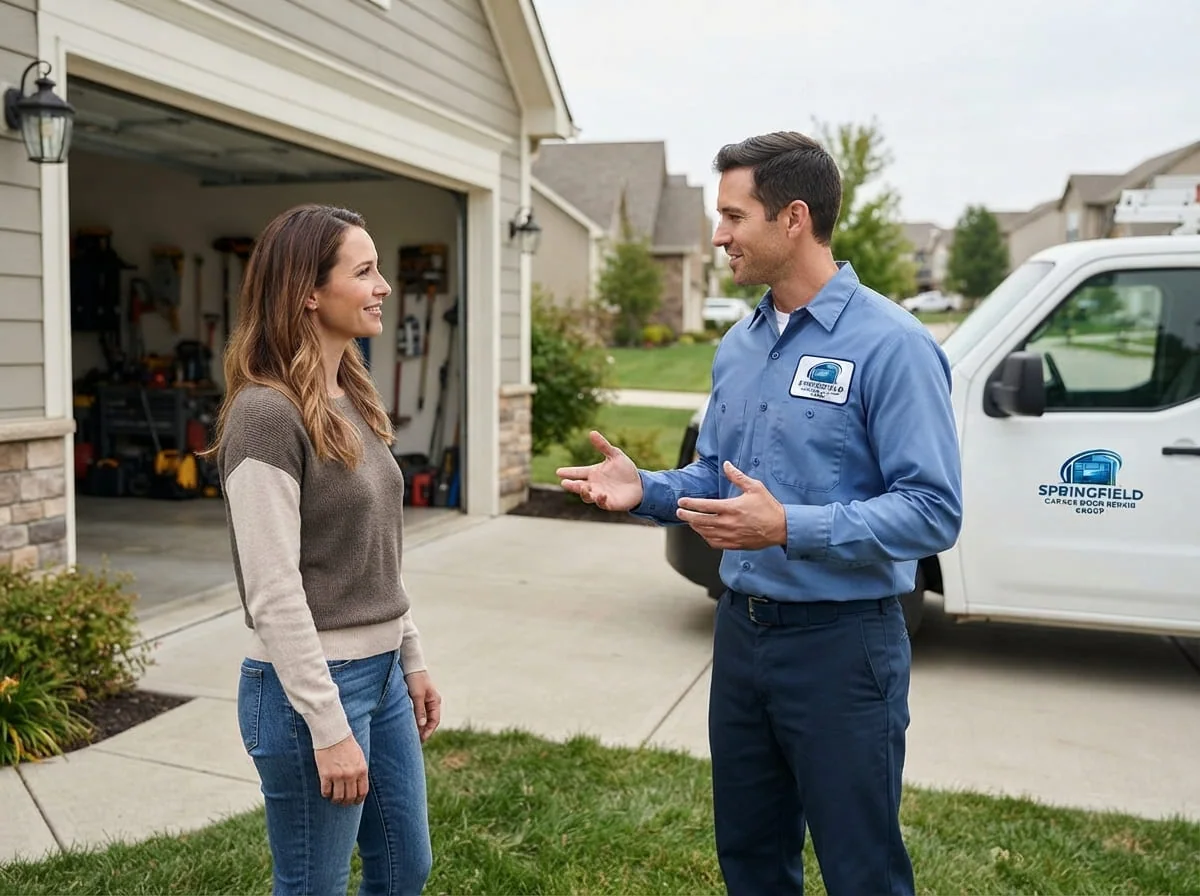
A homeowner calls two companies about the same problem — door won't budge, spring looks snapped in half — and gets back two pieces of paper that don't resemble each other. One lists a service call charge, a spring line item, and labor. The other lists a single total with no breakdown at all. That difference doesn't automatically mean one company is honest and the other isn't, but it does mean you're looking at two different approaches to the same job, and it's worth understanding what separates a legitimate quote from a lazy one.
A garage door is a system, not a single part. Whether it runs on one torsion spring or a matched pair, whether the track is bent or just knocked out of alignment, whether the rollers are worn nylon or rusted steel — all of that changes what a repair actually requires. A repair quote, done properly, is a diagnosis translated into parts and labor. Two technicians can arrive at different numbers for the same symptom if one looked closer than the other, or if one is quoting a patch and the other is quoting a fix that will actually hold.
This article isn't a price list. A number given over the phone without anyone looking at your actual door isn't a quote — it's a guess wearing a quote's clothing. What follows instead is what should show up on paper, what shouldn't, and what to ask before you sign anything.
What Should Happen Before You Ever See a Number
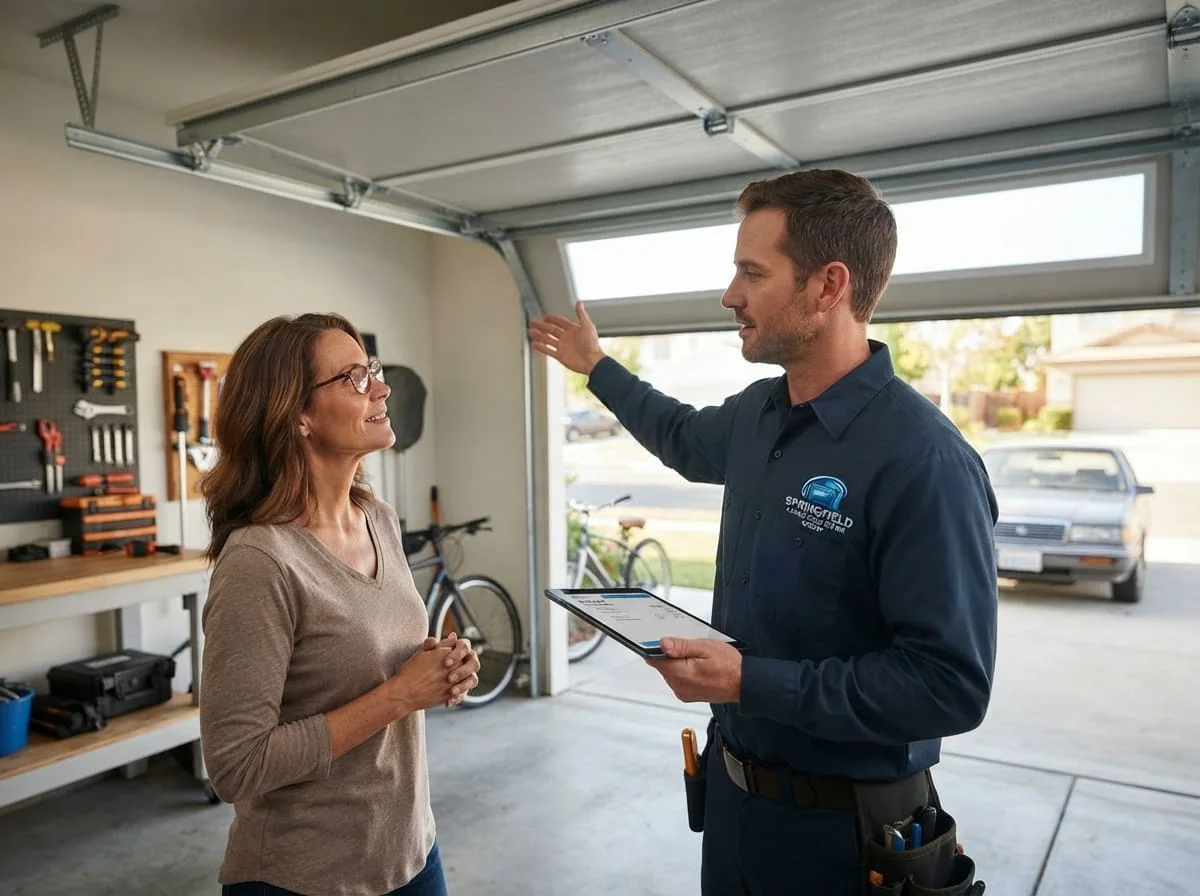
Before a technician writes anything down, they should have actually looked at the door. That sounds obvious, but it's the step that gets skipped most often, especially by phone-quote operations working off a script. A real diagnostic visit means physically checking the spring — its wire gauge, coil count, and whether it's wound to the correct tension for the door's weight — along with the cables, the rollers, the track alignment, the hinges, and, if there's an opener involved, its force and limit settings.
On a torsion spring system, that includes checking whether the door is running on a single spring or a matched pair, because a pair under uneven tension will wear unevenly even if only one half has failed. On an older door, it means checking whether the track itself has been bent by a prior off-track incident, which won't show up if the technician only looks at the spring.
If a company can tell you exactly what's wrong and exactly what it will cost before anyone has stepped into your driveway, that's a sign they're quoting a category of problem, not your specific door. It's a fair question to ask directly: did you diagnose this in person, or are you quoting based on what I described over the phone?
The Line Items a Legitimate Quote Should Include
A written estimate should be readable by someone who has never worked on a garage door. That means each cost driver gets its own line rather than being folded into a single total you're asked to take on faith. At minimum, expect to see:
- A diagnostic or service call charge — often waived or credited if you proceed with the repair, but it should be disclosed either way, before the technician starts working.
- Parts, itemized by component — spring or springs, cables, rollers, hinges, center bearing plate, or track sections, each listed separately rather than lumped into "hardware."
- Labor as its own line, distinct from parts, so you can see what you're paying for the technician's time versus the physical materials.
- Disposal or haul-away of the failed hardware, if that applies.
- Adjustment or calibration work — resetting opener force and travel limits, re-tensioning cables, or realigning track — which is often the difference between a repair that lasts and one that fails again in a few months.
If your door runs on two torsion springs and one has failed, a legitimate quote will generally address both, even if only one is broken. Torsion springs are installed and cycle-rated as a matched pair; replacing only the failed side leaves two springs of unequal remaining life doing the same job, and the second one tends to fail not long after. A technician who explains that reasoning, rather than just adding a second spring to the invoice with no comment, is doing the job the way it should be done.
Understanding Parts Without Needing an Exact Price
You don't need to become a hardware expert to read a quote intelligently, but a little context helps you ask better questions. Torsion springs are rated in cycles — one cycle being a full open-and-close of the door — and industry reference standards published through DASMA, including ANSI/DASMA 102 and TDS 190, describe how that cycle life is calculated based on wire diameter, coil count, and the spring's working tension. A higher cycle-life spring is built to handle more open-and-close cycles before it fatigues, which matters most for doors that get used many times a day.
A quote doesn't need to state a specific cycle number to be trustworthy, but it's reasonable to ask what's being installed and why that's the right spring for your door's daily use. The same logic applies to rollers: sealed ball-bearing rollers are a different product than plain plastic rollers, and a technician should be able to tell you which is being quoted and why, without you having to interrogate them for it.
Extension springs, still found on some older Springfield-area doors, carry a different safety profile than torsion springs. The U.S. Consumer Product Safety Commission has published guidance on this specifically because a failed extension spring under tension can become a projectile without a containment cable installed. If your door uses extension springs and the quote doesn't mention safety cables, that's worth asking about directly.
Red Flags in a Written or Verbal Quote
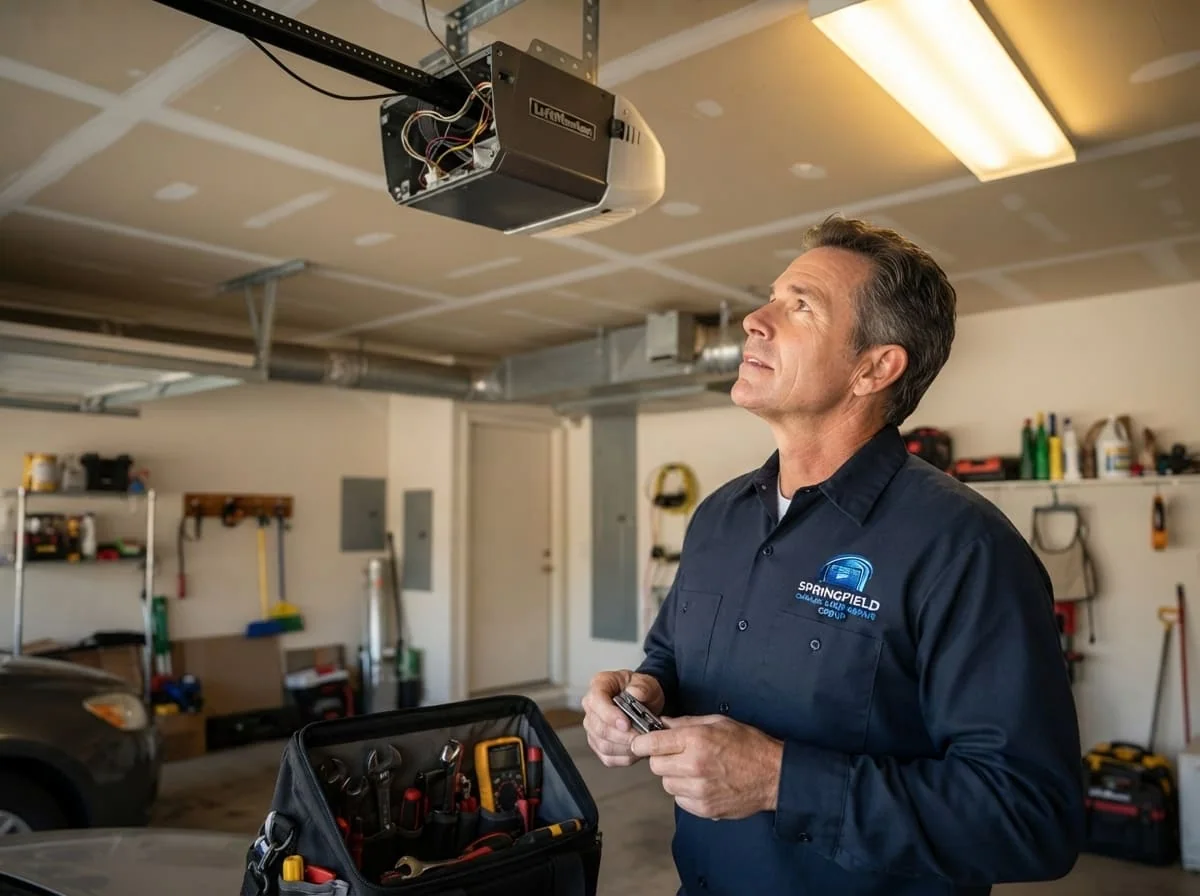
Most red flags in this trade aren't about a specific number being too high or too low. They're about how the quote was arrived at and how it's presented. Watch for:
- A price with no in-person inspection. If nobody has looked at your door, or even asked detailed diagnostic questions over the phone about symptoms, hardware type, and door weight, the number isn't grounded in your actual situation.
- A single lump sum with no breakdown. You should be able to see what's parts, what's labor, and what's a service fee.
- Pressure to decide immediately, especially framed as a one-day-only discount. Legitimate pricing doesn't usually need an artificial deadline to be accepted.
- A demand for full payment before any work begins. It's reasonable for a company to expect payment on completion; it's a different matter entirely to be asked to pay in full before a technician has touched the door.
- No business information on the paperwork. A legitimate estimate carries the company's name, address, and contact information, not a blank sheet with a number on it.
- An unwillingness to explain what actually failed. You should walk away from the conversation understanding why the part broke, not just that it needs replacing.
None of these red flags are about price level. A quote can be entirely reasonable in scope and still be a bad sign if it was produced without ever inspecting your door, or if you're being rushed into signing before you've had a chance to think it over.
Questions Worth Asking Before You Approve the Work
A short list of direct questions will tell you more about the quality of a quote than almost anything else. Before approving any work, it's reasonable to ask:
- What exactly failed, and why did it fail?
- Is this a single spring or a matched pair, and if it's a pair, why is only one being replaced (or why are both)?
- Does the price change if you find something additional once the panel, track, or opener housing is open?
- Can I get this in writing before you start?
- What happens to the old hardware — is it removed and hauled away, or left behind?
- Roughly how long will this take, and will the door be left open or unsecured at any point during the repair?
A technician who's confident in the diagnosis will answer these without hesitation, usually in plain language rather than jargon. If the answers feel evasive, or if the person quoting the job seems unable to explain the mechanism behind the failure, that's worth weighing as much as any number on the page.
Repair Quote or Replacement Quote? A Different Conversation
Sometimes what starts as a repair call turns into a conversation about replacing the door itself, particularly on older doors in Springfield's established neighborhoods where the door may be original to the house. A section of an older sectional door, a badly rusted track, or an opener that's failed alongside the spring can all push the math toward replacement rather than component repair. That's a legitimate conversation to have, but it should be an honest one rather than an upsell.
A trustworthy quote separates the two options clearly: here's what a targeted repair would involve and roughly what condition it would leave the door in, and here's what full replacement would look like, so you can compare them on your own terms. What it shouldn't do is push replacement without a clear mechanical reason — a bent track section or a single broken cable is not, by itself, a reason to replace an entire door.
If a company recommends replacement over repair, ask them to explain specifically what condition of the door or its hardware makes repair impractical. "It's just easier for us" isn't a mechanical reason. "The track is bent in three places and the panel it's mounted to has rusted through" is.
Why Springfield's Climate Shows Up in Your Quote
Central Illinois winters put real, specific stress on garage door hardware, and it shows up in what technicians see and quote through the colder months. Cold temperatures cause torsion springs to contract slightly, which changes the tension they're holding and makes an already-fatigued spring more likely to snap during those first few opens of a frigid morning. Metal track contracts too, which can bind a door that was running fine in warmer months. Nylon rollers get brittle in sustained cold and are more prone to cracking, and opener lubricant thickens, adding strain to the motor on doors that already have marginal spring tension.
None of that changes the honesty of a quote, but it does explain why a technician working in Springfield through January and February sees more failed springs and stiff tracks than one working the same job in a milder climate. If your quote mentions checking or adjusting things beyond the single obviously broken part — track alignment, roller condition, lubrication — that's often the winter climate talking, not padding.
What a Trustworthy Quote Looks Like, Start to Finish
Put together, a legitimate garage door repair quote follows a simple sequence: an in-person or thoroughly detailed diagnosis, an itemized breakdown of parts and labor tied to what was actually found, a written estimate you can review before work begins, and a technician willing to explain the reasoning behind every line rather than just the total.
Springfield Garage Door Repair Group provides free upfront quotes before any work starts, specifically so homeowners can see the breakdown, ask questions, and make the decision on their own terms rather than under pressure. That approach costs nothing to offer and it's the same standard the trade should hold itself to everywhere, not just here.
Explain the mechanism, don't just replace the part. If a homeowner can't tell you why something failed after you've quoted the repair, you haven't finished the diagnosis yet.

Grant Callahan
Owner and lead technician at Springfield Garage Door Repair Group, serving Springfield, IL since 2013.
FAQs
How much does a garage door repair quote usually cost to get?
A written quote itself should be free, and Springfield Garage Door Repair Group provides free upfront quotes before any work begins. The final repair cost depends on what's actually found during diagnosis — which components failed, whether a matched pair of springs needs replacing rather than one, the condition of the track and rollers, and how much labor the specific repair requires. Because those factors vary door to door, an honest quote is built after inspection, not before it.
Should I get more than one quote before approving a garage door repair?
It's reasonable to get a second opinion, especially for a larger repair like a full track replacement or an opener paired with a spring failure. What matters more than collecting several numbers is comparing how each quote was produced: was the door actually inspected, is the estimate itemized, and can the technician explain why each part is being replaced. A well-explained quote from one visit is often more useful than three unexplained totals.
Why did two companies quote different repairs for what seems like the same problem?
This usually comes down to how thoroughly each technician diagnosed the door rather than one company inflating the job. A spring failure can look identical from the driveway while the underlying cause differs — one door may only need the spring, another may also have a bent track section or worn rollers contributing to the failure. A quote that addresses more than the single obvious symptom isn't necessarily padded; it may reflect a closer inspection.
Is a written estimate necessary, or is a verbal quote over the phone fine?
A verbal number given without an in-person inspection should be treated as a rough starting point, not a commitment. Before any work begins, ask for a written estimate that breaks down parts and labor. This protects you if the scope changes once the technician opens things up, and it gives you something concrete to review rather than relying on memory of a phone conversation.
Can I negotiate a garage door repair quote?
You can always ask questions about a quote, including whether a lower-tier part is available or whether certain adjustment work is strictly necessary, and a straightforward technician should be willing to walk through those tradeoffs with you. What you shouldn't need to negotiate is transparency itself — an itemized breakdown and an explanation of what failed should be offered up front, not extracted through back-and-forth.
What's the difference between a diagnostic fee and the repair cost?
The diagnostic or service call charge covers the technician's time to inspect the door and identify what's actually wrong, separate from the parts and labor needed to fix it. Many companies apply that fee toward the repair cost if you move forward with the work the same visit, though that should be stated clearly rather than assumed. Ask whether the diagnostic charge is credited toward the final invoice before the technician starts.
Have a Garage Door Problem Right Now?
Skip the guesswork — call Springfield Garage Door Repair Group for a fast, honest diagnosis.