
The 15-Minute Maintenance Routine
A practical, month-by-month garage door maintenance routine that actually catches problems early, written for Springfield's swing between humid summers and hard winter cold.
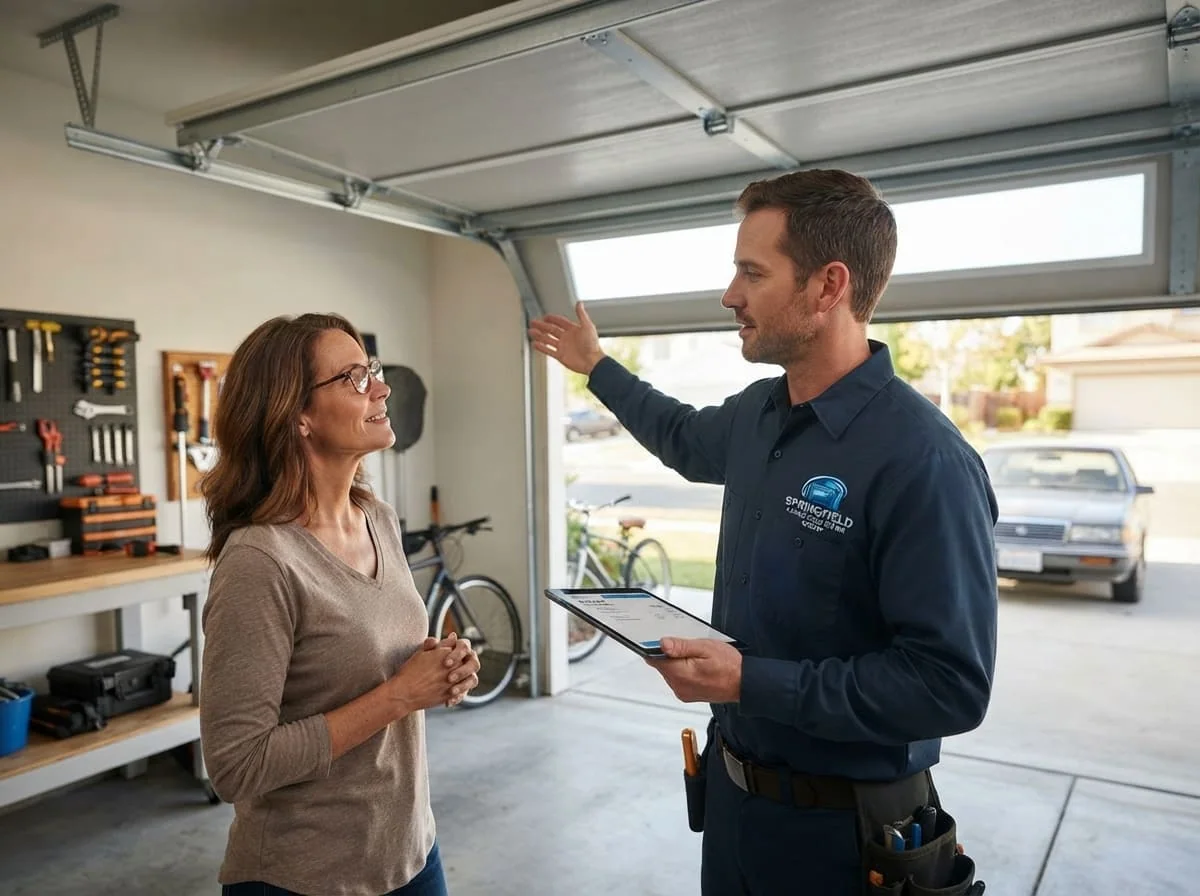
Why Fifteen Minutes a Month Beats an Emergency Call
Almost nobody wakes up to a garage door that simply refuses to work. What actually happens is slower and quieter: a roller starts squeaking in October, a track picks up a slight bow nobody notices in November, a spring loses a little tension over a cold snap in January, and by February the door is grinding, sagging on one side, or stuck halfway. Each of those symptoms was visible weeks earlier to anyone who looked. The point of a short monthly routine isn't to turn you into a technician. It's to catch drift while it's still a five-minute fix instead of a Saturday-morning failure.
Springfield's climate makes this routine more useful here than in a lot of places. A typical January runs a high near 33 degrees and a low near 18, with real cold snaps that go lower, and that swing does specific things to a garage door system. Steel torsion springs contract and stiffen in cold, which changes how much force they deliver on a given wind. Track hardware contracts too, and a track that was a hair out of alignment in July can bind in January. Nylon rollers get more brittle as temperatures drop, so a roller that's been quietly cracking all summer is more likely to fail in the cold. Lubricant thickens and does less of its job right when the door is working hardest against stiff cold air seals. None of this means the door is broken. It means small maintenance items matter more here than in a mild, stable climate, and a homeowner who checks the same handful of things every month has a real advantage.
This checklist covers what's genuinely safe and useful for a homeowner to do without tools or training beyond a flashlight and a step stool. It also draws a hard line around what to look at but never touch, because a garage door spring system stores a serious amount of mechanical energy and the wrong kind of confidence around it is how people get hurt.
The Balance Test: The One Check That Tells You the Most
If you only do one thing from this article, do this. A properly balanced garage door should be able to sit still at any point in its travel without the springs or the opener holding it there. That balance is what lets the opener motor lift roughly 150 to 200 pounds of door using a motor barely stronger than a kitchen mixer. When the balance drifts, the motor starts compensating, and that's exactly when openers burn out gears or strip drive components trying to do a job the springs used to do.
To test it, disconnect the opener by pulling the red manual release cord, which detaches the door from the trolley so you're lifting the door by hand, under spring power only. With the door fully closed, lift it manually to about waist height and let go. A properly balanced door will stay put, or drift down only slowly. A door that slams down or shoots upward on its own has a spring problem, and that's not a DIY adjustment. Torsion springs are wound under enough tension that home adjustment is a genuine injury risk, which is why this test is designed to tell you something is wrong without requiring you to fix it yourself.
Do this test with the door fully open too, letting it come down about a foot and checking that it holds. Testing at both ends of the travel catches a spring that's only slightly off, which a mid-point test alone can miss. If either test fails, stop using the opener until a technician has looked at the springs, since continuing to run a poorly balanced door through its opener accelerates wear on parts that are expensive to replace.
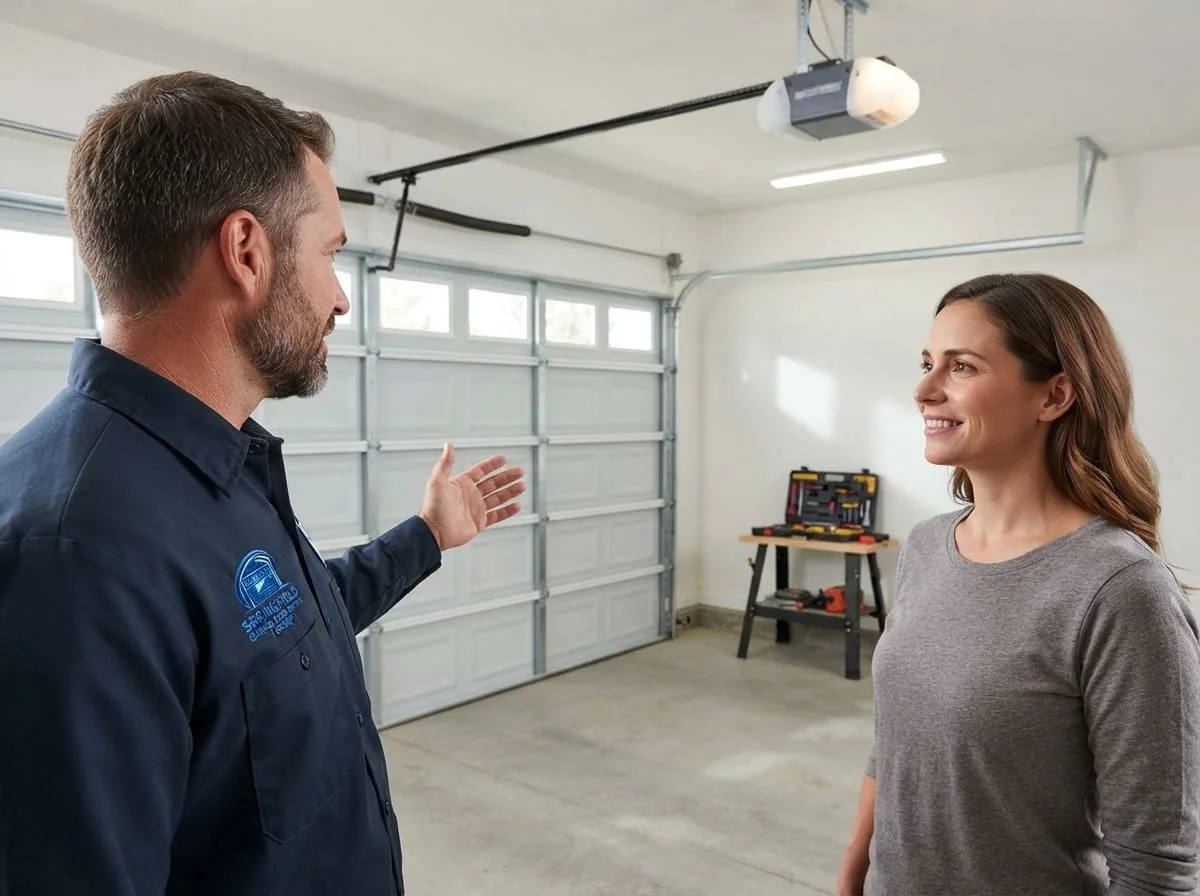
Springs: Inspect From a Distance, Never Adjust Yourself
Most residential garage doors built in the last few decades use one or two torsion springs mounted on a shaft directly above the door opening, rather than the stretched extension springs that run along the horizontal tracks on older systems. Either way, your job is to look, not touch. With the door closed, check the spring coils for rust, for any visible gap or separation between coils that shouldn't be there, and for a spring that looks stretched or thinner in one section than the rest. Surface rust alone isn't an emergency, but pitting or flaking rust weakens the wire and shortens the spring's remaining life.
Torsion springs are engineered and rated for a certain number of open-close cycles before they're expected to fail, a standard formalized in ANSI/DASMA 102 and in DASMA's technical guidance on spring cycle life. A door that opens four times a day on a standard-cycle spring will wear through that rated life meaningfully faster than the same door on a higher-cycle spring, which is one reason two houses with what looks like the identical door can have very different spring lifespans. If you don't know which type is on your door, that's a normal thing to ask a technician during any visit rather than something to guess at.
If your home still has older extension springs, check that each one has a safety containment cable running through its center. The U.S. Consumer Product Safety Commission has documented serious injuries from extension springs that failed without a containment cable in place, since an uncontained spring under tension can travel with real force when it breaks. If you see a bare extension spring with no cable through it, treat that as a priority item to have corrected, not a maintenance detail to note and revisit later.
Tracks, Rollers, and Hinges: A Five-Minute Visual Sweep
Walk the length of both vertical tracks with a flashlight while the door is closed. You're looking for three things: dents or bends in the track rail, debris or hardened grease buildup inside the track channel, and gaps between the track and its mounting brackets where a bracket has worked loose. A track doesn't need to be dramatically bent to cause problems. Even a small inward dent can make a roller bind slightly on every single cycle, and that repeated friction is what eventually cracks a roller or knocks a door off-track entirely.
Rollers are worth a closer look than most homeowners give them. Spin each one by hand if you can reach it safely, and look for a flat spot worn into what should be a round wheel, for visible cracks in a nylon roller, or for a roller that wobbles side to side on its stem instead of turning cleanly in place. Nylon rollers are the most common type on newer residential doors because they run quieter than steel, but they're also the type most affected by Springfield's winter cold, since the material gets measurably more brittle as temperatures drop. A roller that's been developing hairline cracks all summer is far more likely to actually fail during a hard January cold snap than in July.
- Check each hinge where door panels connect for looseness, missing screws, or a hinge pin that's worked partway out
- Look at the bottom bracket and roller bracket on each side for rust streaking, which often means a roller bearing is failing and shedding metal
- Note any track section where the gap between roller and track looks wider or narrower than the rest, which usually signals a bend rather than normal wear
Anything you find here is usually a contained, specific repair rather than a system-wide problem. Roller replacement and track repair are both narrow, predictable jobs precisely because catching the wear early keeps the damage from spreading to the rest of the hardware.
Photo-Eye Sensors and the Auto-Reverse Test
Every garage door opener sold in the United States for residential use since the early 1990s is required to include two safety systems: photo-eye sensors mounted a few inches off the floor on each side of the track, and a mechanical or electronic auto-reverse that stops and reverses the door if it meets resistance while closing. Both exist because a garage door is the single largest moving object in most homes, and both are worth testing on a real schedule rather than assuming they still work because the door still closes.
Start with the sensors. Most have a small LED on each unit; a solid, steady light on both usually means proper alignment, while a flashing or dark light typically means the sensors are misaligned, dirty, or blocked. Wipe the lenses with a soft cloth, since dust and cobwebs are a genuinely common cause of a door that refuses to close for no obvious reason. Then check alignment by eye. The two sensors need to be pointed directly at each other; even a slight bump from a stored bike or a broom can knock one out of line.
To test auto-reverse, close the door using the wall button or remote and place a solid object like a 2x4 flat on the ground in the door's path. The door should touch the object and immediately reverse back open. If it doesn't reverse, or if it reverses only after pushing hard against the object, stop using the opener and treat it as a safety repair, not routine maintenance. This is one of the few checks in this whole routine that isn't optional or a matter of preference. For more detail on diagnosing sensor issues specifically, our guide to garage door safety sensors walks through the more common failure patterns.
Lubrication Done Right (and the Products That Do More Harm Than Good)
Lubrication is where good intentions cause the most accidental damage. The parts that genuinely need lubrication are the rollers (at the bearing, not the wheel surface), the hinges at each pivot point, the torsion spring coils with a light coat, and the lock mechanism if your door has one. Tracks should never be lubricated. A track is meant to be clean and dry; oil on a track just collects dust and grit into a gritty paste that increases friction instead of reducing it, which is the opposite of what most people expect.
Product choice matters more than people assume. A light, white lithium grease or a silicone-based spray lubricant made specifically for garage door hardware penetrates into the moving joint and stays put through temperature swings. A general household penetrating oil or an all-purpose spray lubricant, by contrast, is formulated mainly as a solvent and light rust preventative. It flashes off quickly, leaves little actual lubricating film behind, and tends to attract dust into a sticky residue within a few weeks. It's a fine product for freeing a stuck bolt. It's a poor long-term choice for a hinge that cycles hundreds of times a month.
Apply lubricant sparingly, twice a year at minimum and closer to quarterly if your door is noisy or gets heavy daily use, then wipe off any excess so it doesn't drip onto the floor or attract more grit than it prevents. If the door is still noisy after a proper lubrication pass on rollers and hinges, the noise is usually coming from somewhere lubrication can't fix, like a worn roller bearing or a loose panel, and that's a sign to have the door looked at directly rather than a case for more oil.
Weatherstripping and Cold-Weather Prep for Sangamon County
Weatherstripping doesn't get much attention because it doesn't affect whether the door opens and closes, but it does a lot of quiet work protecting everything else. The bottom seal and the side and top weatherstripping keep out wind-driven rain, block cold air from reaching the garage interior, and reduce the temperature swing that hardware and lubricant experience day to day. Check the bottom seal for cracking, flattening, or gaps where it's pulled away from the door, and check the side seals for the same. A bottom seal that's cracked or compressed lets in more cold air than most homeowners expect, and that cold air is exactly what accelerates the spring stiffening and roller embrittlement covered earlier in this checklist.
This is especially worth checking before the first hard freeze each year, since a seal with minor wear in October can tear the rest of the way during a January cold snap when the rubber is already stiffer and less forgiving. Homes in older Springfield neighborhoods with detached, unheated garages, and homes in outlying communities like Chatham with larger detached garage structures, tend to see this wear a little faster simply because the garage interior swings closer to outdoor temperature extremes than an attached, insulated garage does. If you're not sure whether your seals are original to the door, that's a reasonable thing to ask about during any service visit, since replacement seal material is inexpensive relative to the protection it provides for the hardware behind it.
The Once-a-Year Deeper Check: Hardware and Cables
Beyond the monthly routine, set aside time once a year, ideally in early fall before the weather turns, for a slightly deeper pass. Go around every track bracket, hinge, and roller bracket with a wrench or screwdriver and snug anything that's worked loose. A garage door cycles thousands of times a year, and ordinary vibration loosens fasteners gradually the same way it does on anything else that moves repeatedly. A loose bracket is a simple tightening job when caught early and a track alignment problem when ignored for a year or two.
Look closely at the lift cables running from the bottom brackets up to the drum near the springs. You're checking for fraying, for individual strands sticking out from the cable, or for a cable that looks rusted where it wraps around the drum. As with springs, this is a look-only item. A frayed cable under tension is not something to test, tug on, or attempt to re-seat, since a cable failure while under load can happen suddenly and with real force. Treat any visible fraying as reason to schedule a repair rather than something to monitor for a few more months.
Diagnose before you quote, and treat a homeowner's door with the same care you'd give a commercial account. That's been the standard since I started doing this out of a single van in 2013, and it hasn't changed.
That once-a-year pass is also a good time to have a technician run a full inspection alongside your own, since some checks, like precise spring tension and opener force settings, really do need a trained eye and the right tools. You can schedule an inspection with our team for that annual deeper look, timed around your own maintenance routine rather than around a symptom that's already becoming a problem.
Turning the Checklist Into a Habit That Actually Sticks
The routine above only works if it actually happens every month, and the honest failure mode for most homeowners isn't forgetting how to do it, it's forgetting to do it at all. Tying it to something else already on a monthly rhythm works better than relying on memory alone. Pairing it with a furnace filter change, a smoke detector battery check, or the first Saturday of the month gives it a trigger that already exists in your household routine.
Keep the bar low enough that it actually happens. The balance test, a visual sweep of tracks and rollers, and a look at the weatherstripping cover the highest-value checks in about the fifteen minutes this article is named for. Lubrication and the deeper hardware pass don't need to happen every single month to be effective. What matters most is noticing change over time. A roller that looked fine in June and has a hairline crack in September tells you something a single inspection never could.
Some findings are genuinely outside the scope of a homeowner checklist, and that's fine. Spring tension, cable replacement, and track realignment are jobs where the right call is scheduling a technician rather than working through it yourself, and knowing the difference between a five-minute tightening job and a job that needs a trained set of hands is really the whole point of doing this routine consistently. Our approach has always been to explain the mechanism, not just replace the part, and a homeowner who's been running this checklist for a year usually already understands more about their own door than they expect to when they call.

Grant Callahan
Owner and lead technician at Springfield Garage Door Repair Group, serving Springfield, IL since 2013.
FAQs
How often should I actually run this checklist?
The core visual checks, balance test, tracks, rollers, and weatherstripping, are worth doing monthly since they take about fifteen minutes and catch problems while they're still small. Lubrication is effective on a twice-a-year schedule, closer to quarterly if the door gets heavy daily use or has started making noise. Save the deeper hardware and cable check for once a year, ideally in early fall before winter puts more stress on the system.
Is it safe to adjust or lubricate torsion springs myself?
Lightly lubricating the spring coils is fine and recommended. Adjusting spring tension is not something to do yourself. A torsion spring is wound under significant force specifically so it can lift a heavy door, and that same stored force makes home adjustment a real injury risk. If the balance test in this article shows a problem, that's the signal to call a technician rather than attempt an adjustment.
How much does professional garage door maintenance cost?
Cost depends on what the inspection finds, how many components need adjustment, and whether any parts like rollers or cables need replacing rather than just servicing. There's no way to give an honest number without seeing the door. We provide free upfront quotes before any work begins, so you'll know exactly what's involved before committing to anything.
My garage door is noisy but still opens and closes fine. Does it still need attention?
Noise is usually the earliest symptom a garage door gives before a more serious failure, which is exactly why it's worth addressing rather than waiting out. New noise almost always traces back to a worn roller bearing, a loose hinge or bracket, or lubricant that's gone dry, and all three get more expensive to fix the longer they're left running.
How do I know if something I found needs a same-day repair versus routine maintenance?
A failed balance test, a failed auto-reverse test, a frayed cable, or a bare extension spring without a containment cable are all reasons to stop using the door and call for service rather than wait. Surface rust on a spring, a slightly worn roller, or minor weatherstripping wear are real findings worth fixing but don't require stopping use of the door immediately.
Can this checklist replace a professional inspection entirely?
No, and it isn't meant to. It's designed to catch obvious drift between professional visits and to give you enough information to describe a problem accurately when you do call. Spring tension, precise opener force calibration, and structural track alignment are all things that genuinely benefit from a trained technician's tools and experience, even for a homeowner who runs this routine faithfully every month.
Have a Garage Door Problem Right Now?
Skip the guesswork — call Springfield Garage Door Repair Group for a fast, honest diagnosis.